

2026 Original Research
The 2026 SC Digital
Presence Index: What we found
when we looked at 11,534 businesses.
We audited every Google Business Profile we could find across 18 South Carolina counties and 20 business categories, scoring each one on traditional local search readiness and AI search readiness. The results were stark.
Key Findings
The numbers that matter.
0
Zero businesses in South Carolina earned an A grade for AI search readiness. Not one.
Out of 11,534 businesses audited across 18 counties and 20 categories, not a single business scored in the top grade tier for AI search readiness.
The average AI readiness score was 24.7 points below the same business's traditional GBP score. The gap between where these businesses are and where they need to be is significant, and most of them don't know it yet.
24.7
Average AI readiness gap
The average business scored 24.7 points lower on AI readiness than on traditional GBP completeness. A business that looks well-optimized for Google Maps is frequently invisible to AI-powered search tools.
1,392
At-risk businesses identified
We flagged 1,392 businesses statewide as "at-risk", defined as having a significant AI readiness gap combined with low review volume or incomplete profile data. These are the businesses most likely to lose ground as AI search grows.
#1
Greenville leads SC in digital presence
Greenville County ranked first in South Carolina for overall digital presence score, outpacing Charleston, Columbia, and the other 15 counties in the study. But even Greenville's top businesses had significant AI readiness gaps.
45.7
Pediatricians: the least AI-ready category
Pediatric medical practices averaged the lowest AI readiness score in the entire study at 45.7, despite being a category where patients actively research providers before making a decision. High trust, low visibility.
2026
AI search is already a real factor
ChatGPT, Perplexity, and Google AI Overviews are already influencing how consumers find local businesses. Most SC businesses are optimized for 2018 search behavior. The gap between where they are and where customers are looking is widening fast.
How We Scored Them
Two scores. Two very different pictures.
Every business in the study received two scores: a traditional GBP score and an AI readiness score. They measure different things, and most businesses perform much better on the first than the second.
The grading scale below shows what each tier represents. No business in the state reached the A tier on AI readiness. Most fell in the C and D range.
A
90 to 100, Fully optimized
Comprehensive GBP, strong reviews, structured data, AI-visible content, consistent NAP across all platforms.
B
75 to 89, Well established
Strong GBP with minor gaps. Decent review volume. Some AI readiness work done but not complete.
C
60 to 74, Getting by
Basic profile present. Reviews exist but inconsistently managed. AI readiness largely unaddressed.
D
45 to 59, Significant gaps
Incomplete profile, low review count, no AI optimization, inconsistent directory listings across the web.
F
Below 45, At risk
Minimal or unclaimed GBP, few or no reviews, essentially invisible in both traditional and AI local search.
By County
How South Carolina counties stack up.
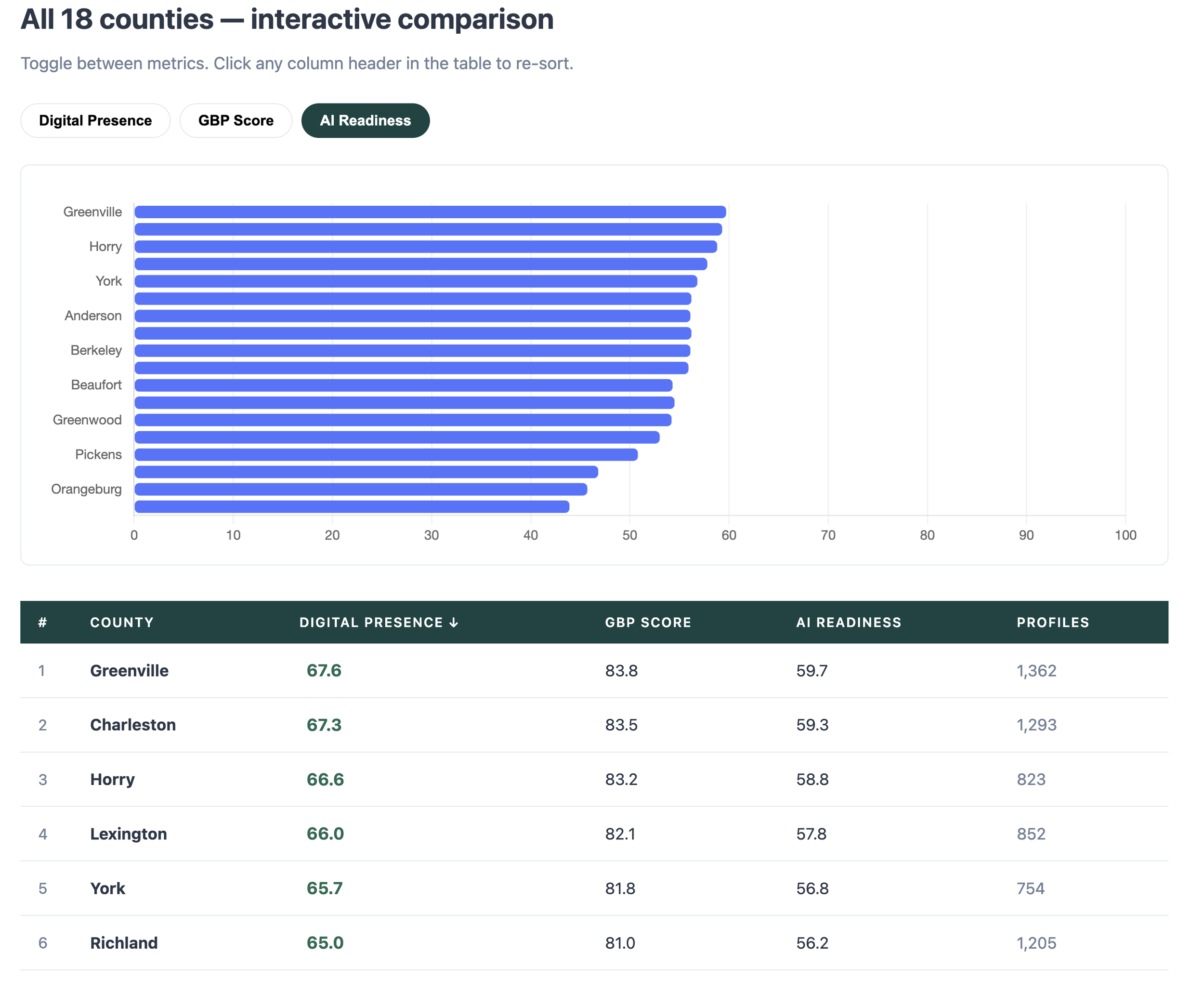
Greenville led the state overall, but every county had significant room for improvement, particularly on AI readiness. Here are the top and bottom performers.
Rank #1
Greenville
Overall score: 82.4 | AI readiness: 57.1
Highest overall digital presence in the state. Strong restaurant and professional services categories. AI readiness still trails GBP score by 25 points.
Rank #2
Charleston
Overall score: 80.1 | AI readiness: 55.4
Strong hospitality and real estate scores driven by tourism-facing businesses. Trades and professional services categories lag significantly.
Rank #3
Richland (Columbia)
Overall score: 77.8 | AI readiness: 52.3
State capital market with a mix of government-adjacent services and university-area businesses. AI readiness gap is among the largest in the top five counties.
Rank #16
Marlboro
Overall score: 48.2 | AI readiness: 31.4
Lowest overall score in the study. Rural market with predominantly small, owner-operated businesses. High concentration of unclaimed or incomplete GBP profiles.
Rank #17
Allendale
Overall score: 45.9 | AI readiness: 29.8
Smallest business density in the study. Many local businesses have no GBP at all, meaning they don't appear in any local or AI search results regardless of service quality.
Most Improved Opportunity
Horry (Myrtle Beach)
Overall score: 71.2 | AI readiness: 44.1
High tourist volume drives GBP completion in hospitality. But the local services market, HVAC, plumbers, contractors, is dramatically underoptimized given the density of customers searching locally.
What This Means for Your Business
This isn't a future problem.
It's a right now problem.
AI-powered search isn't coming. It's here. ChatGPT, Perplexity, and Google AI Overviews are already influencing how customers find local businesses, and the businesses losing ground to this shift don't know it yet.
AI search tools recommend businesses, and most local businesses aren't in the running.
When someone asks an AI tool to recommend a local HVAC company, dentist, or attorney, those tools pull from structured web data: your website content, your GBP, your reviews, your mentions across the internet. Businesses with more complete, consistent, authoritative data show up in the recommendations. Most local businesses haven't done this work. The ones who do it first will own an enormous advantage.
A strong GBP score no longer means you're visible where it counts.
Our data shows clearly that traditional GBP optimization and AI readiness are two different things. A business can score an 80 on GBP completeness and a 52 on AI readiness, meaning they're well-positioned for 2020 search behavior and poorly positioned for 2026 search behavior. These are different optimization tracks and most agencies are only managing one of them.
The businesses that move first will be the hardest to displace.
AI search recommendations build on authority signals that compound over time: review volume, content depth, structured data, consistent mentions across the web. The businesses building these signals now will be the ones AI tools recommend in two years. Waiting means catching up to competitors who got there first.
This is a local market opportunity, not just a technical one.
Because adoption is so low, zero businesses in SC earned an A on AI readiness, any business that invests in this work stands out in their local market immediately. This isn't about competing nationally. It's about being the most visible business in your category in your county. That's a very achievable bar right now.
Methodology
How we built the study.
The 2026 SC Digital Presence Index was built using a combination of automated data collection, manual verification, and a structured scoring rubric developed across both traditional and AI search dimensions.
01
Business Discovery
We collected Google Business Profile data for businesses across 18 SC counties and 20 categories using Google Maps API and Outscraper. Only active, claimed profiles were included in the scored dataset.
02
GBP Scoring
Each profile was scored on completeness: business name, categories, description, hours, photos, services, website link, review count, and average rating. Weighted rubric with a 100-point scale.
03
AI Readiness Scoring
A separate rubric assessed each business's likely visibility in AI-generated recommendations: structured web content, citation consistency, review recency and depth, schema markup signals, and AI answer presence.
04
Gap Analysis
We calculated the delta between each business's GBP score and AI readiness score to identify the at-risk segment, businesses that appear well-optimized in traditional search but are invisible in AI-driven recommendations.
Find out where your business stands before your competitors do.
Book a free strategy call and we'll walk through what the data means for your specific business, category, and market, and what it would take to close the gap.